
Quick Peek Inside
I still remember the first time I pulled my own natal chart on a free astrology site. A circle. A bunch of symbols I couldn't name. And a pit in my stomach that said: this is either nonsense or way too much work.
It turned out to be neither. What is a natal chart? It's a snapshot of the sky the moment you were born. Nothing more, nothing less. But here's the catch — most explanations online stop right there and leave you with a pretty circle and zero clue what to do with it.
So let's fix that. I've been reading birth charts for over a decade, and I've watched hundreds of people glaze over during the "this is your rising sign" speech. This guide skips the mystical fluff and gets into what actually matters: the pieces, the practical reading order, and the stuff nobody tells beginners until they've already gotten lost.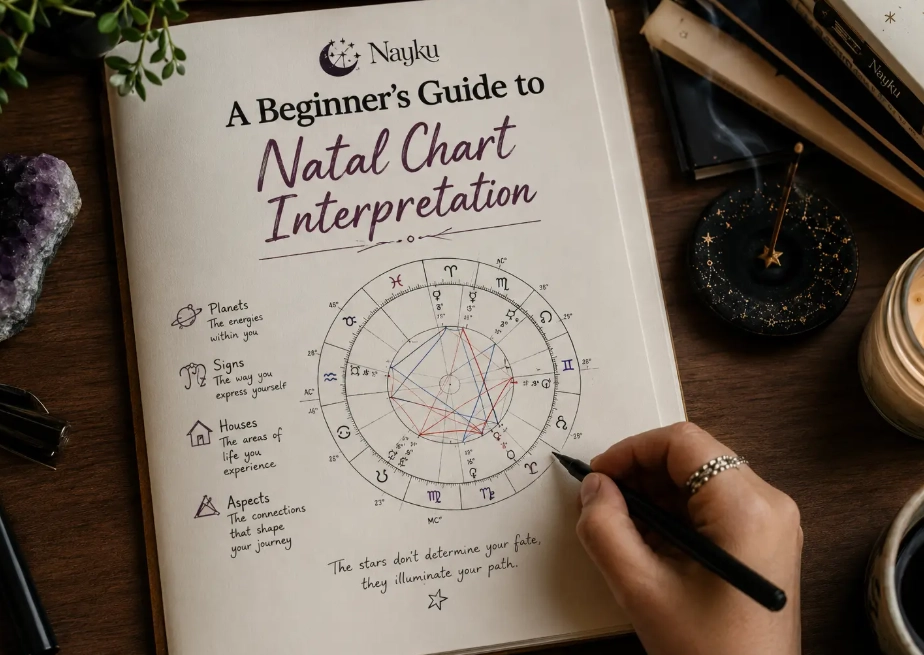
So, What Actually Is a Natal Chart?
A natal chart (also called a birth chart) is a map of the zodiac wheel with the sun, moon, and planets placed exactly where they were in the sky at your birth — down to the minute and the specific geographic location. Change the time by four minutes, and your rising sign might shift. Change the city, and some house placements move too.
That's why astrologers keep asking for your exact birth time. It's not gatekeeping. It's math.
Here's what the chart is not: a fortune-telling device that tells you if you'll marry rich or die alone. If someone hands your chart back with those predictions, walk away. A natal chart is an interpretation framework, not a crystal ball.
Case in point: my client Maya had a Cancer sun and swore she hated emotional drama. Her Aries moon and Capricorn rising told a completely different story. She laughed when I pointed it out. "That's the stuff I yell about internally and never show anyone." That's the chart working.
How to Read a Birth Chart Without Losing Your Mind
The biggest trap is trying to read everything at once. You'll drown in symbols. Here's the order I actually use when I sit down with a chart, whether it's mine or someone else's:
- Step 1 — Confirm the birth data. Check the time on your birth certificate, not just what your mom remembers. I once spent a full hour reading a chart only to find out the birth time was rounded to "around 6 PM." The rising sign was off by two houses. That's a huge difference.
- Step 2 — Identify the big three. Sun (core self), moon (emotional wiring), rising (how you meet the world). This alone gets you 60% of a basic reading.
- Step 3 — Locate the chart ruler. The ruler of your rising sign. If you don't know the rulerships, stick with the sun and moon for now. But don't ignore this part forever — the chart ruler is often the missing puzzle piece.
- Step 4 — Check for clusters (stelliums). Three or more planets in one sign or house. These are the loud parts of your chart. They dominate.
- Step 5 — Look at aspects to the sun and moon. Squares, trines, oppositions. No need to memorize every orb angle. Just note what's making contact.
If that feels like a lot — it is. Nobody reads a chart in five minutes. Anyone who says otherwise is selling you something.
Where Most People Get Stuck
Houses. Houses trip up almost every beginner. Think of signs as flavors and houses as rooms in your life. A planet in your 7th house shows up in partnership territory. Same planet in the 4th house? It's about home and roots. This is why two Leos can feel completely different from each other.
I'll admit something: I ignored houses for the first two years of my own chart obsession. My readings were shallow and I knew it. Once I learned the house system, everything clicked.
Biggest Beginner Mistakes I See All the Time
These are the ones I hear repeatedly from people who've been reading their own charts for a while and keep hitting walls:
- Treating the sun sign like the whole chart. "I'm a Libra, but I hate balance" — no, you're a Libra with a Scorpio moon. Big difference.
- Reading a planet placement in isolation. A Jupiter in Sagittarius sounds great until you notice it squares Saturn. Context matters.
- Using the wrong house system. Placidus is the default on most sites, but Whole Sign changes the whole picture. If your chart feels off, try switching systems before you write off astrology completely.
- Forgetting that aspects to the ascendant matter too. People forget the angle itself is a sensitive point.
These aren't beginner stumbles. They're intermediate mistakes — meaning they hit you right when you think you've got it figured out.
Sign, Planet, House: A Real Example
Here's a quick reference table showing how the same planet changes meaning depending on sign and house. Use this as a mental model, not a rule book.
| Planet | Sign | House | What It Often Looks Like in Real Life |
|---|---|---|---|
| Mercury | Gemini | 3rd house | Quick, chatty, curious — text messages at all hours, strong local connections |
| Mercury | Gemini | 9th house | Same quick thinking, but aimed at philosophy, travel, big-picture learning |
| Venus | Taurus | 2nd house | Loyal in love and money — likes tangible proof of affection, invests in quality |
| Venus | Taurus | 7th house | Same steadiness but directed at partnerships — loyal friends, long-term relationship focus |
| Mars | Aries | 1st house | Direct, impulsive, physically energetic — jumps first, asks later |
| Mars | Aries | 10th house | Aggressive career drive, takes charge at work, hates slow bosses |
Notice how the planet stays the same and the sign stays the same, but the house arrows the energy at a different life area. This is the single most useful chart-reading habit you can build.
Natal Chart vs. Sun Sign: What's the Real Difference?
The sun sign is one line in a 14-page report. It's the headline, not the article. The natal chart adds the moon, the rising, the houses, the aspects, the retrogrades, the chart ruler, the nodes if you're advanced — and every one of those pieces modifies the others.
I've seen sun-sign astrology get dismissed as "newspaper horoscopes." Fair criticism. But the natal chart is a different animal. It's specific enough to feel uncanny sometimes. Not because the universe is whispering in your ear, but because complex systems always have a way of holding up a strange mirror.
Questions People Ask Me After Their First Reading
I don't know my exact birth time. Is my natal chart useless?
Not useless — just half-blind. You'll lose the rising sign and house placements, but the sun, moon, and aspects between planets are still solid. Many astrologers work with a "solar chart" when birth time is unknown. It's not the full picture, but it covers a lot. The one thing I'd caution against: don't guess your birth time just to get a rising sign. A wrong time creates a wrong chart, and a wrong chart creates confusion that takes a while to untangle.
Why does my natal chart not feel like me at all?
Two culprits, in my experience. First, the birth data is off — especially the time. Second, you're reading a single placement in isolation (like just the sun) and ignoring the rest. I once worked with someone who swore her Pisces sun was "totally wrong" — but her moon in Capricorn and rising in Virgo explained almost everything she felt. Charts are a team effort. The sun doesn't work alone.
Can a natal chart tell me when I'll meet my partner?
No. This is where charts get overpromised. A birth chart shows your relationship patterns — what you're drawn to, where friction tends to show up. It doesn't show timing. Anyone who gives you a specific month or year from a birth chart alone is mixing in predictive astrology (which is a whole separate practice) or just making things up. The healthier approach: use the chart to understand your patterns, not to schedule your life.
How long does it take to learn how to read a natal chart?
The basics — sun, moon, rising, the twelve houses, the run-through of planets — maybe three to four months of casual study. Reading fluently? Longer. I'm still finding new layers years in. The trap is thinking you need to master everything before you can read anything. Start with the big three. The rest will make more sense once those three feel natural.
What's the one placement in a natal chart most people ignore?
The chart ruler. Hands down. It's the planet that rules your rising sign, and it's the thread that ties the chart together. I ignored it for way too long. If your rising sign is Gemini, watch your Mercury — sign, house, and aspects. You'll suddenly understand why certain themes keep popping up in your life.
This article was fact-checked against standard astrological definitions and cross-referenced with common chart-reading practices. Interpretations in astrology are not scientifically validated; treat them as a reflective tool, not a substitute for professional advice.
Reader Comments